
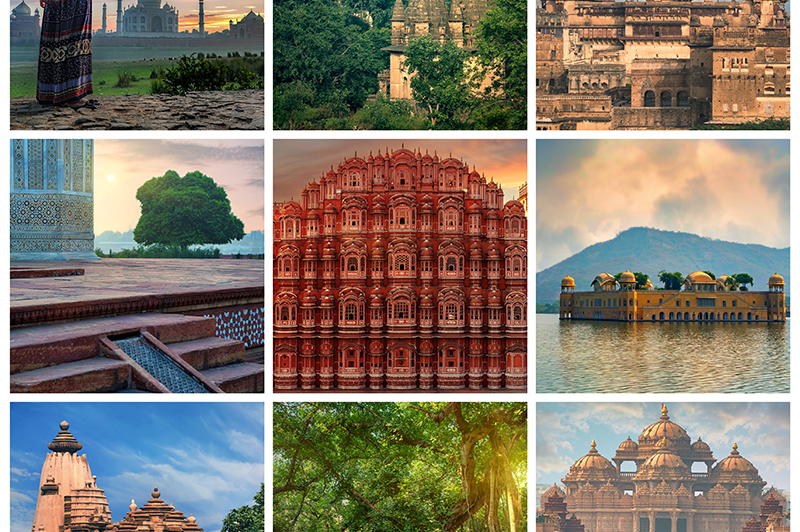
India’s royal history has left behind some of the most breathtaking architecture on Earth. From desert fortresses to lakeside marble retreats, the country’s palaces tell stories of maharajas, empires, and dynasties that once ruled vast kingdoms. Whether you’re drawn to Mughal grandeur, Rajput fortitude, or colonial-era opulence, here are ten palaces that deserve a spot on your India itinerary.
1. City Palace, Udaipur
Perched on the banks of Lake Pichola, the City Palace in Udaipur is actually a complex of palaces built over nearly 400 years by successive Mewar rulers. Its blend of Rajasthani and Mughal architecture is striking, with courtyards, balconies, and towers offering sweeping views of the lake and the surrounding Aravalli hills. Inside, the Crystal Gallery and the mirror-encrusted Sheesh Mahal showcase the lavish tastes of Udaipur’s royal family. Sunset here, watching the city glow gold over the water, is one of Rajasthan’s quiet magic moments.
2. Lake Palace, Udaipur
A short boat ride from the City Palace sits the Lake Palace, a white marble structure that appears to float on Lake Pichola. Originally built in the 18th century as a summer retreat for Maharana Jagat Singh II, it’s now a luxury hotel, but boat tours let non-guests admire its beauty from the water. With courtyards full of bougainvillea, lotus ponds, and intricately carved pillars, it’s often cited as one of the most romantic buildings in the world. Even from a distance, the palace’s reflection on the still lake is unforgettable.
3. Mysore Palace, Mysore
In the southern state of Karnataka, the Mysore Palace is a riot of Indo-Saracenic architecture, domes, arches, and stained glass, all combined into one royal residence. Built for the Wadiyar dynasty in the early 1900s after a fire destroyed the original wooden palace, it remains one of India’s most visited monuments. The palace truly comes alive during Dussehra, when nearly 100,000 lights illuminate its facade, and on Sunday evenings, when a smaller light display still draws crowds. Inside, the Durbar Hall’s painted ceilings and gilded pillars reflect the wealth of South India’s princely states.
4. Amber Fort, Jaipur
Just outside Jaipur, the Amber Fort rises dramatically from a hilltop overlooking Maota Lake. Built primarily by Raja Man Singh I in the late 16th century, it combines defensive fort architecture with the delicate artistry of a palace. The Sheesh Mahal, or Mirror Palace, is the highlight: a hall where thousands of tiny mirrored tiles once turned a single candle’s flame into a galaxy of light. Many visitors arrive by elephant or jeep up the winding fort road, adding a sense of old-world ceremony to the visit.
5. City Palace, Jaipur
Within Jaipur’s old walled city, the City Palace remains a working royal residence, part of it open to the public as a museum. Built by Maharaja Sawai Jai Singh II, the same visionary who designed Jaipur’s famous pink-hued streets, the palace mixes Rajput, Mughal, and European architectural elements. The Chandra Mahal’s upper floors are still home to the royal family, while the Mubarak Mahal displays an extraordinary collection of royal textiles and weapons. The courtyards, painted in soft pastel hues, are some of the most photographed spots in Rajasthan.
6. Hawa Mahal, Jaipur
Technically a palace facade rather than a full residence, the Hawa Mahal, or “Palace of Winds,” deserves its place on this list for sheer architectural ingenuity. Built in 1799, its honeycomb of 953 small windows was designed so royal women could observe street life and festivals without being seen, while the perforated structure kept the rooms cool even in Rajasthan’s punishing summer heat. Seen at sunrise, when the pink sandstone glows warmly against the sky, it’s an iconic image of Jaipur.
7. Umaid Bhawan Palace, Jodhpur
One of the last great palaces built in India, Umaid Bhawan Palace was completed in 1943 and remains partly a royal residence, partly a luxury hotel, and partly a museum. Constructed from golden-hued Chittar sandstone, it’s considered one of the largest private residences in the world. Its Art Deco interiors, designed in collaboration with a Polish architect, set it apart from the older Rajput palaces, offering a glimpse into how Indian royalty adapted to a changing 20th century while holding onto tradition.
8. Falaknuma Palace, Hyderabad
Built in the late 19th century by a nobleman of the Nizam’s court and later acquired by the Nizam of Hyderabad himself, Falaknuma Palace is a scorpion-shaped marvel of Italian marble, Belgian crystal chandeliers, and English furniture. Today it operates as a heritage hotel, but its banquet hall, library modeled after Windsor Castle, and rooftop views over Hyderabad make it worth visiting even for a meal or afternoon tea. The palace is a reminder of just how cosmopolitan India’s royal courts had become by the turn of the century.
9. Padmanabhapuram Palace, Kerala/Tamil Nadu
Tucked near the Kerala-Tamil Nadu border, Padmanabhapuram Palace is one of the finest examples of traditional Kerala wooden architecture in India. Once the seat of the Travancore kings, its interiors feature intricately carved teak ceilings, Chinese porcelain floors, and murals made from a unique mix of natural dyes that have survived for centuries. Unlike the marble and sandstone grandeur of North India, this palace shows a quieter, earthier kind of royal craftsmanship, built to suit Kerala’s tropical climate.
10. Jai Vilas Palace, Gwalior
In the heart of Madhya Pradesh, Jai Vilas Palace was built in 1874 by the Scindia rulers of Gwalior, blending Tuscan, Italian, and Corinthian architectural styles. Its Durbar Hall houses two of the largest chandeliers in the world, reportedly hung only after eight elephants were used to test the ceiling’s strength. The palace museum also displays an eccentric silver toy train that once carried after-dinner brandy and cigars around the dining table, a quirky detail that captures the playful extravagance of India’s princely states.
Planning Your Palace Trail
Many of these palaces are clustered closely enough to combine into a single trip, particularly the Rajasthan circuit of Udaipur, Jaipur, and Jodhpur. Others, like Mysore, Hyderabad, and the Kerala palace, are worth building into a broader South India itinerary. Whichever route you choose, visiting in the early morning or late afternoon will help you avoid both the crowds and the midday heat, and give you the best light for photographs. India’s palaces aren’t just relics of the past, they’re living monuments to centuries of artistry, ambition, and royal imagination.